
Xiconomics: From trade tracks to tech ties

An aerial drone photo taken on 湖南石化新闻网Aug. 3, 2025 shows a sightseeing train running on a 7-arch bridge on the Yunnan-Vietnam Railway in Kaiyuan City of southwest China's Yunnan Province. (Photo by Li Yunsheng/Xinhua)
Amid a sluggish global economy, the two close neighbors have leveraged their geographical proximity, mutual need and steady diplomacy to create one of the world's most dynamic bilateral economic relationships, with cooperation spanning infrastructure, trade, people-to-people exchanges, artificial intelligence (AI) and green energy.
HANOI, April 17 (Xinhua) -- For many young people in Hanoi, riding the Cat Linh-Ha Dong metro line to snap skyline photos or even take wedding portraits has become a fashion.
The metro line, which has cut once-congested cross-city travel to just 23 minutes, now stands as a symbol of modern urban life in the capital of Vietnam, enabled by an ever deepening practical economic partnership between China and the Southeastern Asian country.
Amid a sluggish global economy, the two close neighbors have leveraged their geographical proximity, mutual need and steady diplomacy to create one of the world's most dynamic bilateral economic relationships, with cooperation spanning infrastructure, trade, people-to-people exchanges, artificial intelligence (AI) and green energy.
FAST-TRACKING ENGAGEMENT VIA INFRASTRUCTURE
Infrastructure has long been the backbone of China-Vietnam economic integration. The Cat Linh-Ha Dong metro line is a key cooperation project that has received high attention from Chinese President Xi Jinping, who mentioned the project several times in his signed articles in Vietnamese media.
During talks with Vietnamese President To Lam, who is on a four-day state visit to China, Xi said both countries should work together in their modernization drive, accelerate the alignment of development strategies and prioritize infrastructure connectivity.
Beyond urban transit, the two countries are pushing ahead with cross-border rail links and smart port upgrades.
In the southern Chinese city of Nanning, the T8701 train departs daily for Hanoi, while the return train, T8702, departs from Gia Lam Station in Hanoi to China each evening. This daily cross-border passenger rail service strengthens the bond between the two nations.
The China-Vietnam railway cooperation mechanism was launched in 2025 during Xi's visit to Vietnam, his fourth state visit to the country. Currently, three standard-gauge railway projects in northern Vietnam are being advanced by both sides and have achieved positive breakthroughs.
The enhanced physical connectivity has led to growing people-to-people exchanges. Chinese visitors topped the list of international arrivals to Vietnam in 2025, accounting for 25 percent of all foreign tourist visits, or more than 5.28 million visitor arrivals, up 41 percent from a year earlier.
Short distance, shared culture and ease of travel have made Vietnam a favored getaway. The launch of the China-Vietnam tourism cooperation year for 2026-2027, announced during the two leaders' meeting on Wednesday, further strengthens this growing exchange.
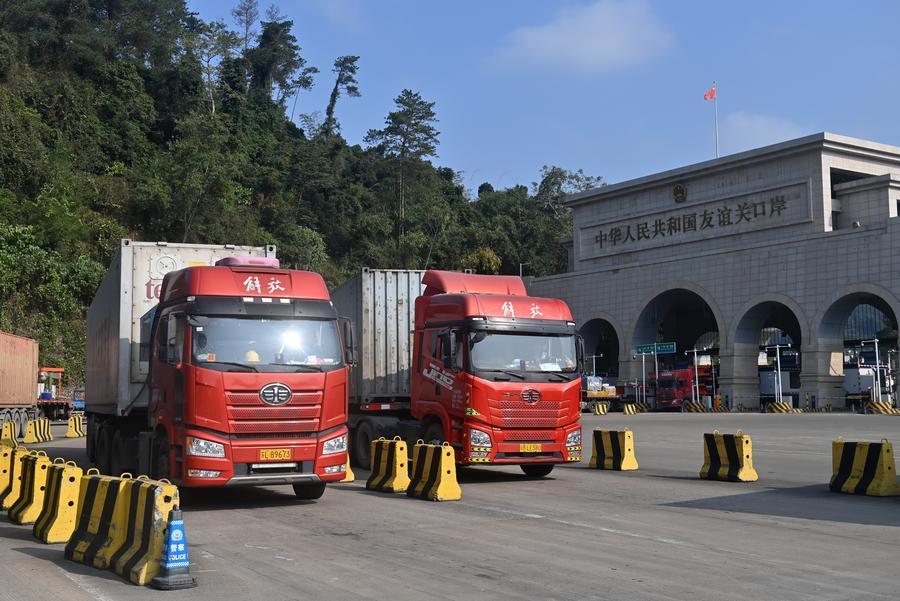
Vehicles bound for Vietnam are pictured after customs clearance at Youyiguan Port, or Friendship Pass, in Pingxiang City, south China's Guangxi Zhuang Autonomous Region, Jan. 28, 2026. (Xinhua/Lu Boan)
SHARED HUGE MARKETS
The robust economic relationship is also reflected in trade: China has been Vietnam's top trading partner for more than two decades. In 2025, bilateral trade surged past 290 billion U.S. dollars, a historic high. Vietnam remains China's largest trading partner in the Association of Southeast Asian Nations and its fourth-largest globally.
The relationship is mutually beneficial and deeply related to ordinary people, especially for farmers.
In 2025, Vietnam's fruit and vegetable exports to China exceeded 5 billion dollars, accounting for more than 64 percent of its total fruit and vegetable exports. Vietnam durian and fresh coconut exports have become highly sought-after in China.
China is also the fastest-growing export market for Vietnam's aquatic products, including fish and shrimp. In 2025, such exports reached 2.45 billion dollars, rising 29 percent year-on-year.
More high-quality Vietnamese products are welcome to enter the Chinese market, Xi said on Wednesday.
In return, China supplies Vietnam with machinery, components and raw materials that fuel the country's manufacturing boom.
"The key driving force behind the strong growth of economic and trade cooperation in recent years lies in the internal demand for development cooperation of each country, along with their respective advantages and complementarities," said Nguyen Thi Phuong Hoa, a senior researcher at the Vietnam Academy of Social Sciences.
Bilateral cooperation in trade is expected to shift toward higher-value-added activities and promote official exports, especially in agricultural products, processed foods and technology-intensive industrial goods, she said.
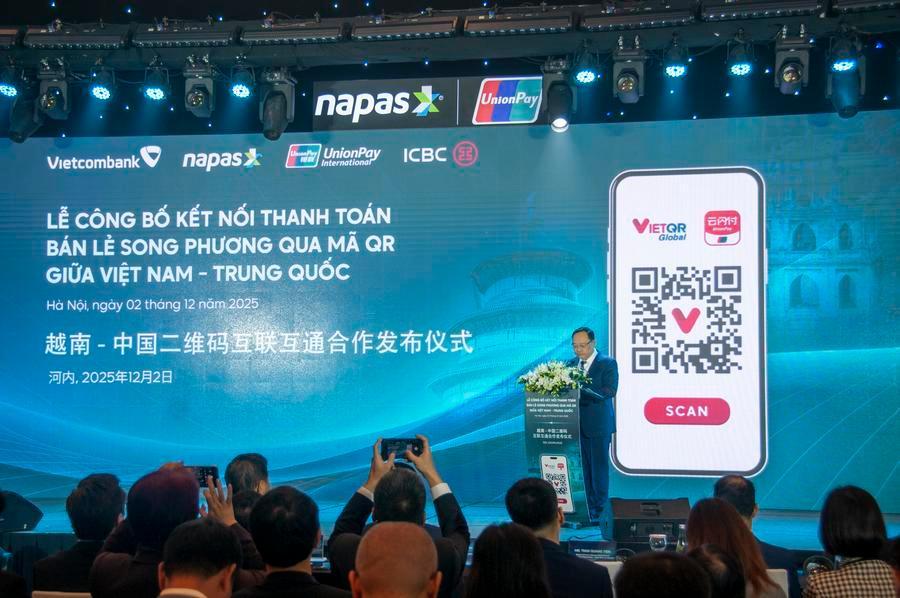
China and Vietnam launches a bilateral QR code payment service in Hanoi, Vietnam, Dec. 2, 2025. (Photo by Vu Trung Kien/Xinhua)
NEW FRONTIERS
During To Lam's visit, the two countries signed cooperation documents covering a number of areas, including inter-party exchanges, public security, judicial cooperation, economy, industrial and supply chain cooperation, among others.
While the economic partnership between the two countries continues to leverage their current complementary strengths in traditional sectors, it is also strategically oriented toward future-facing demands, enabling them to better address global challenges and seize new opportunities in a changing world.
Notably, in the current context, both countries share similar development needs for the new phase, Nguyen Thi Phuong Hoa noted.
Vietnam has identified science, technology, innovation and digital transformation as strategic priorities and the primary drivers for rapid and sustainable development. Meanwhile, China's 15th Five-Year Plan (2026-2030) also prioritizes high-quality development, technological self-reliance, green transformation and higher-level opening-up, she said.
Vietnam's push into smart, digital and green economies has opened opportunities for Chinese expertise. Chinese-built renewable energy projects -- solar farms, wind installations and waste-to-energy plants -- have formed a huge clean energy cluster, supporting the country's energy transition and helping to alleviate power shortages that have long hampered industrial growth.
On AI, China's Guangxi province has taken a lead by launching an innovation center with Vietnam to develop Vietnamese-language large models and train technical workers. In 2025 alone, five AI training sessions were held for more than 200 Vietnamese participants.
During talks with To Lam, Xi called on both sides to strengthen cooperation in emerging fields such as artificial intelligence, semiconductors, and the Internet of Things.
Vietnam-China economic relations are expected to continue growing strongly and steadily, thanks to new driving forces, the researcher said.
(责任编辑:新闻浮世绘)
- 新春逛黄山许村:诗书传家,古村有戏更有味
- 视频丨伊朗最高领袖政治顾问:伊朗可降低浓缩铀丰度 但不会转至国外
- 一把剪刀能“剪”出怎样的人生?坐着轮椅的她这样说
- 春运首日送服务 护航群众平安行
- 我国2024年货物贸易规模居世界第一
- 美军称击落一架接近其航母的伊朗无人机
- 科学解读|2026年“马年无春”真相:历法现象 无关吉凶
- 咸丰县2026年新春市集火热开市
- 家庭医生让群众有“医”靠!广东推动公卫服务进万家
- 贯彻落实省两会精神③丨矢志不渝、 用心用情护民生
- 来凤县第二届年货节“寻味”开市!民俗“嘉年华”点燃武陵山新春采购热
- 新春走基层丨在蓝天之上 守护万家灯火
- 今年全国粮食总产量达13908.2亿斤(新数据 新看点)
- 前“大厂”精英,为何选择葛店?
- 我国2024年货物贸易规模居世界第一
- 这个科技小院,在藏北高原“种草”
- 前“大厂”精英,为何选择葛店?
- 荆江岸畔春风起 文明实践谱新篇——江陵县春风行动圆满举行
- 中国科大科技商学院正式开建
- 春运首日,记者夜访宜昌北站旅客夜间休息室。
- 金兰 莱芜新闻网 views+
- 增城腾讯新闻网 views+
- 驻马店市文化路新闻网 views+
- 南昌市开发区新闻网 views+
- 温州新闻网报道 views+
- 旬阳县无人机新闻网 views+
- 兰州新区二十四路新闻网 views+
- 雷州新闻网2018 views+
- 青岛新闻网. views+
- 上饶公安新闻网最新消息 views+